 CastGhost
Every pitch needs an address, and finding the right one is harder than it looks. A podcast's name is often a common phrase, its website might be a page on a hosting platform, and the email you find first might belong to a guest's publicist.
I spent two weeks testing how CastGhost finds hosts' emails against the paid search tools, scoring every result against addresses I'd found by hand. Since then I've watched it run for guests in four different niches. Here's what I learned, including why some niches are much harder than others.
The short version
- Most hosts publish an email somewhere the show controls: its RSS feed, its Apple Podcasts listing or its website. Start there.
- Search engines find pages that mention the show, which isn't the same as finding the show's address. In my tests, Google's AI summary named the wrong address 3 times in 8.
- A working address isn't necessarily the right one. An email check tells you a mailbox exists, not whose it is.
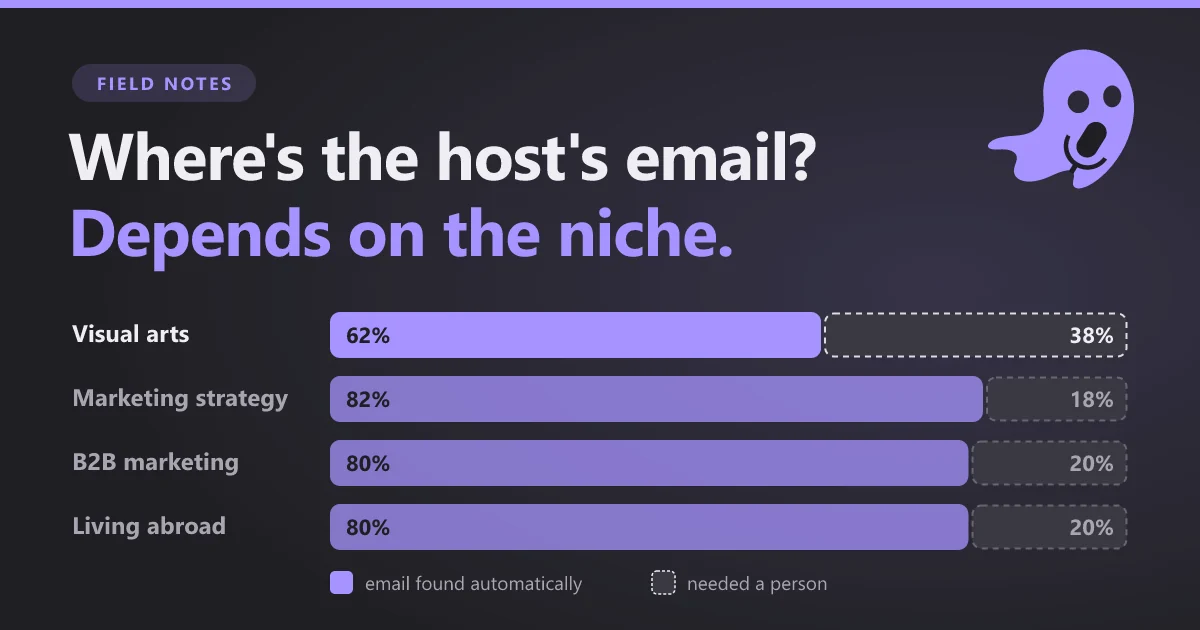
- The niche matters. Art shows needed a person to find the address about twice as often as marketing, B2B and expat shows did.
Where hosts publish their email
Look in this order. The first three are the show speaking about itself, so they're the most reliable.
- The RSS feed. Every podcast has one, and many hosting platforms put the owner's email in it. Some put a forwarding address there instead (a long code at the hosting company's domain), which isn't a person.
- The Apple Podcasts listing. Some shows write their email straight into the description.
- The show's website. The contact page is as often called "Let's Talk" or "Be a guest" as "Contact".
- The host's own website, for every host. The person who created the show and answers its email is sometimes listed second.
- Social profiles: an Instagram bio, a Facebook page's About section, a YouTube channel's About tab or a Linktree. Many small shows publish their address only here.
Why search engines get it wrong
I ran the same two searches for ten shows through Google (via two paid services), Brave and the web search CastGhost uses, and scored them against the addresses I'd found by hand.
- They answer "which pages match these words". Shows called "Studio Break" or "Creative Connections" share their names with dozens of other things, and articles that mention a show match as well as the show's own site does.
- Directories crowd the results. Apple, Spotify and the podcast databases rank above the show's own site, and their "contact" details are usually behind a paywall or guessed.
- Snippets are fragments. One show writes its address as a name followed by "@gmail", without the ".com", and no tool reads that as an address.
- AI summaries blend sources. Google's AI Overview named 8 addresses for the 10 shows: 5 right and 3 wrong, including a gallery's address lifted from episode notes and an address for a different show with the same name. Run it again and it gave different answers.
Google was the best at finding a show's own website. But better links didn't mean more right answers, and on the four shows CastGhost couldn't crack, paid Google searches found two addresses, both wrong.
A working address isn't the right one
Both of those wrong addresses were real, working mailboxes, and the email check passed them. One belonged to another podcast; the other came from an unrelated Facebook video. A check tells you an address accepts mail. It can't tell you whose mail it is.
The same trap hides in a show's own feed. Episode notes are full of other people's addresses: a guest's publicist, a gallery's bookings. In CastGhost's first version, one of those was marked as the best address to pitch.
So CastGhost checks who a page is about before it takes anything from it. A page has to name the show, or belong to one of its hosts. It sorts what it finds by kind: a host's own address, a booking address, the show's inbox, a company address, a forwarding address, an address that's only mentioned in an episode. Then it pitches the best of them, and never a forwarding address or someone else's publicist while anything better exists. When an address only turned up in a Google summary, check it before you send.
Some niches are harder than others
The ten shows in my test were art podcasts, and about a third of their addresses were only on Facebook, a YouTube About tab or Linktree, where no tool that respects a site's rules can read them. CastGhost found an address for 6 of the 10 on its own.
A run since then for a guest in B2B marketing found an email for 8 of 10 shows and a contact form for a 9th. Six of those emails came from the show's own feed or website; the other two came from Google's AI summary, so they're the two to check.
Here's how matched shows broke down for guests in four niches:
| Niche | Shows | Email in the show's own feed | Email found automatically | Needed a person |
|---|---|---|---|---|
| Visual arts | 13 | 3 (23%) | 8 (62%) | 5 (38%) |
| Marketing strategy | 11 | 7 (64%) | 9 (82%) | 2 (18%) |
| B2B marketing | 10 | 5 (50%) | 8 (80%) | 2 (20%) |
| Living abroad | 10 | 6 (60%) | 8 (80%) | 2 (20%) |
"Needed a person" means no email turned up automatically: someone found it by hand, the show only had a contact form, or it had no address anywhere public.
These are small numbers, a dozen shows a niche, so read them as a pattern rather than a statistic. But the pattern is clear. Art shows put their email in their feed about a quarter of the time, and around 4 in 10 needed a person to find it. In the business niches, the feed held the email half the time or more, and about 2 in 10 needed a person.
My read on why: business podcasts are usually run as part of a business. The host's work address goes in the feed, there's often a booking page, and sometimes a producer answers the inbox. Many art podcasts are one artist's side project, run from Instagram, with the address in a bio or a Linktree, if it's anywhere at all.
If your niche is a creative one, expect to spend a minute on some shows yourself. CastGhost puts the shows it can't find an address for in Needs you, with links to where to look (the show's Linktree, its YouTube About tab, its Facebook page, its Instagram bio) and what to look for on each.
Every show found makes the next search faster
CastGhost keeps every show and contact it finds in a shared catalog: public facts only, never who pitched whom. Half of the B2B guest's ten shows were already in it from earlier searches, so their contacts came back without a new search. Each guest who searches a niche makes it a little quicker for the next.
What it costs
Finding and checking a contact costs CastGhost about 10 cents a show, most of it reading pages rather than searching. That's about 5% of the $2 you pay when a pitch is drafted, and a show with no contact found costs you nothing. See Pricing.