 CastGhost
Most podcast booking tools charge by the month. CastGhost doesn't, and that's deliberate. You add credit when you want to pitch, you pay $2 when a pitch is drafted, and whatever you don't use waits for you, however long that takes.
Here's why I built it that way.
The short version
- Podcast guesting comes in bursts. You pitch hard around a launch, then life takes over. A subscription charges you for both.
- Credit that expires is a subscription in disguise. CastGhost's never expires.
- You pay for pitches, not months. Setting up your profile and finding shows are free. A pitch is $2, including a redraft and its follow-ups.
Podcast guesting comes in bursts
Most people don't pitch podcasts at a steady pace all year. They pitch around something: a book coming out, a product launch, a new service, a funding round. Then client work fills the calendar, a holiday comes round, or it's simply a hard month, and outreach is the first thing to go.
A monthly plan doesn't notice. It bills you in the busy months and the quiet ones alike. So you either keep paying for a tool you've stopped using, or cancel it and pay to start again when the next launch comes round. And in a hard month, when you go through your statements cutting what you don't use, the subscription you've paused in all but name is the easy one to cut.
Credit that expires is a subscription in disguise
Some tools look like pay per use but aren't. You buy a monthly plan, it comes with a set number of credits, and whatever you don't use disappears at the end of the month.
I ran into this when I helped my wife get her paintings ready for limited-edition prints. The service we use to enlarge her image files counts its work in credits, one per file, but sells them as a monthly plan, and unused credits don't roll over. The real cost is per file, yet you're billed per month. I understand why a platform limits credits, since every file costs it something to process. But nothing stops it from letting you buy credits when you need them and keep the ones you don't use. If the tool is good, people will come back and top up.
That's how CastGhost works. Credit you add never expires. Add $50 before a launch, use half of it, and the rest is there next spring.
How CastGhost charges
- Free to start. Setting up your profile and finding shows that fit you cost nothing.
- $2 per pitch. That includes one free redraft and all of the pitch's follow-ups. Each redraft after the first is $0.25, and editing a draft yourself is always free.
- Add what you want to spend, from $10 to $1,000, or save a little with a pack: 27 pitches for $50, or 55 for $100.
- You only pay when a pitch is drafted. A show with no contact found costs nothing, and neither does a draft that fails.
- Credit never expires. It isn't refundable, except where the law requires it, so add what you expect to use.
See Pricing for the details.
What a year of pitching costs
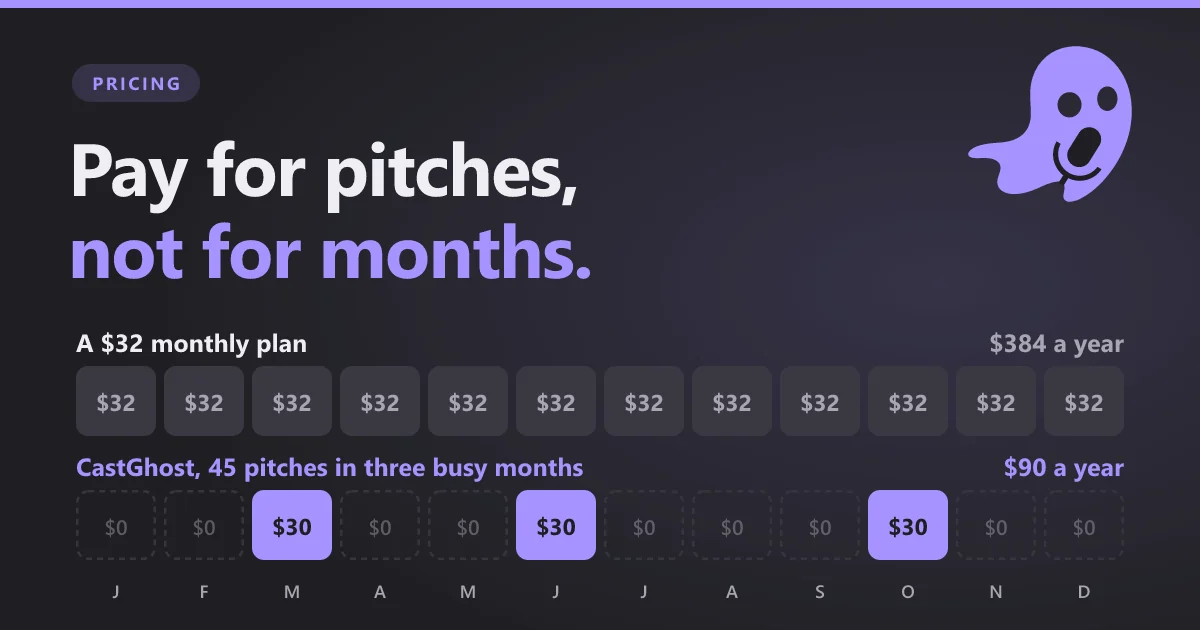
Say you pitch in three busy months a year, 15 shows in each. That's 45 pitches: $90, or a little less with a pack. In the other nine months, you pay nothing.
Or say you pitch ten shows every month, all year. That's 120 pitches: $240 at the standard rate, and less with packs.
A $32 monthly plan, which is what PodMatch charges a guest for Standard and Talks.co charges for Pro paid monthly, comes to $384 over a year, whether you pitch in one month or all twelve. That isn't a like-for-like comparison. A marketplace introduces you to hosts who have signed up to hear from guests, and that's worth something. It's why I'd use one alongside CastGhost rather than instead of it. But it shows what paying by the month costs when your pitching comes in bursts.
Not every subscription is a bad deal
I'm not against subscriptions across the board. Some tools earn a monthly fee because you use them every day: email on your own domain, say, or the software you do your work in. The test I use is simple. Will I use it this month, and next month, and the month after that?
For most guests, podcast pitching doesn't pass that test. And if you do pitch every week, a marketplace plan can be worth its monthly fee, with CastGhost alongside it for all the shows that aren't on one.
"But who pays for updates?"
The usual case for a subscription is upkeep: someone has to keep the software working, so you pay every month for that. I don't buy it. I ship changes to CastGhost every week, and they reach everyone as soon as they go live. There's no plan to upgrade to and no tier that gets new features first.
Each pitch pays for the work behind it, so CastGhost doesn't need to charge you in the months you aren't using it.
Why I built it this way
I started building CastGhost for my own podcast guesting, as part of moving my work off subscriptions wherever I could. I've written more about owning your tools rather than renting them on the BottBott blog.
The short of it: if a tool is worth paying for, you'll come back and pay for it when you need it. CastGhost should earn its $2 each time you use it, not charge you for the months you don't.