 CastGhost
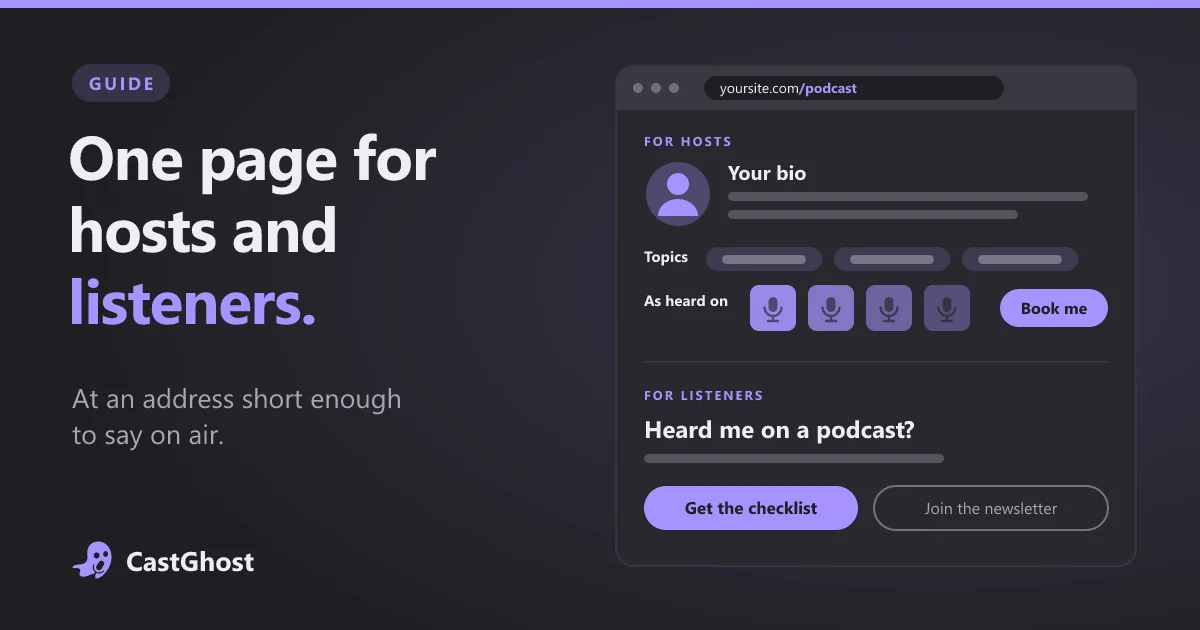
When a host reads your pitch, they look you up. When a listener hears you on a show, they look you up too. Both should land in the same place: one page on your own site, made for podcasts, at an address short enough to say out loud.
Most guests send both somewhere that wasn't built for them: a homepage written for clients, a LinkedIn profile, a link-in-bio page with eleven buttons. A guest page does the job better, and it takes an afternoon.
The short version
- One page, on your own website, at an address you can say on air, like yoursite.com/podcast.
- For hosts: everything they need to say yes and prepare. Your bio, a photo, your topics, past episodes and how to book you.
- For listeners: the thing you promised on the show, and one way to stay in touch.
- It keeps your pitches short, and every link from a show's notes points to a page you own.
Hosts check you out before they say yes
A pitch can only carry so much. Before a host books you, they want to know you're real, that you can hold a conversation, and what you'd talk about. Without a guest page, they piece that together from your homepage, your LinkedIn and a search for your name, and some of them won't bother.
A guest page answers all of it in one place. That also means your pitch can stay short: a few lines on why you fit this show, and a link for everything else. Hosts get a lot of pitches, and the short ones get read.
Listeners need one address to remember
People listen while they drive, walk the dog or do the dishes. They can't click anything, and they won't remember a long address or "find me on LinkedIn". They will remember yoursite.com/podcast.
When they get there, the page should greet them ("Heard me on a podcast? Start here"), give them what you mentioned on the show, and offer one next step. That's how a listener becomes a subscriber.
Every link points to a page you own
Show notes usually link to the guest, and those links come from established sites in your field. If each show links somewhere different (your LinkedIn, a marketplace profile, your homepage), that value is spread thin, and some of it lands on sites you don't own. Point every show at the same page on your own domain, and each appearance adds to it.
Profiles on podcast marketplaces and link-in-bio services are useful, but they live on someone else's site. Keep them, and link from them to your page.
What to put on it
For hosts:
- Your bio, in two lengths: a sentence or two a host can read out as your introduction, and a paragraph for the show notes.
- A photo they can use: a clear headshot at a decent size, with a download link.
- Three to five topics, each with a line on your angle, so a host can picture the episode.
- Past appearances, with links. Even one or two show you can hold a conversation. Add each new one as it goes out.
- How to book you: an email address or a booking link, and your time zone.
- If you have them: a few questions you answer well, and a short clip of you talking.
For listeners:
- A line that greets them, so they know they're in the right place.
- What you promised on air: the checklist, the template, the discount, the first chapter.
- One way to stay in touch: a newsletter sign-up or a booking link. One, not five.
An example
Mine is at simod.me. The page for hosts, simod.me/host, has a read-aloud intro of about 20 seconds, a short and a long bio a host can copy, a headshot to download, six topics with a line on each, and a request to link simod.me in the show notes. The Studio lists every show I've been on, newest first, with a link to the host kit for the next host.
It's laid out like a set of building plans, a nod to my 20 years in renovation. Yours should sound like you, too.
Keep it simple
You don't need a new website. One page on the site you already have is enough, and so is a simple page builder if you don't have a site yet. Keep the address short and easy to spell, use the same one on every show, and update the page after each appearance. Over time it becomes a record of every conversation you've had.
Put it in every pitch
Link the page in every pitch you send. In CastGhost, save it to your link library once, and Add link puts it into any draft. Add the page's link to your profile too: CastGhost reads it with the rest of your work, so the bio and topics you wrote there feed into the pitches it drafts.
Setting up your profile and finding shows that fit you are free. You pay $2 when a pitch is drafted. See Pricing.