 CastGhost
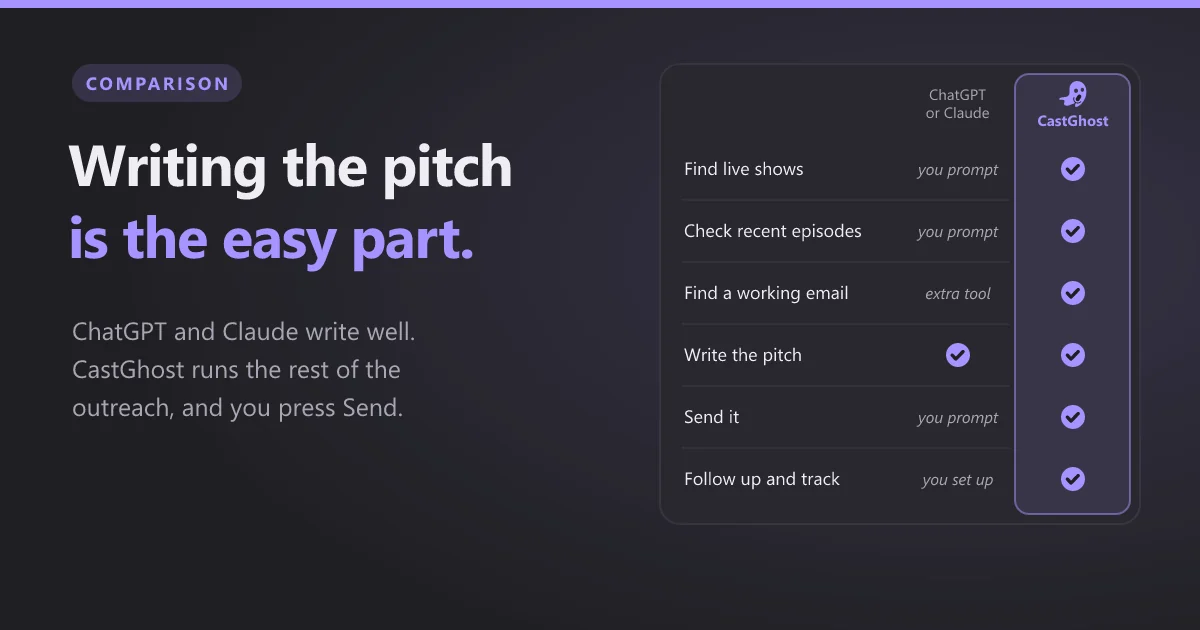
If you already pay for ChatGPT or Claude, it's tempting to run your podcast outreach through it. You can ask it for shows in your niche, for the host's email, and for a pitch draft. And the high-performing models write a pretty good pitch, too.
But the pitch draft is the easy part. Most of the work in podcast outreach is everything before and after it: finding shows that are still active, checking that they fit you (and you them), getting an address that actually works, sending, following up and keeping track of an outreach campaign. A chat assistant can help with each of those, but you have to run it: prompt every step, check every answer and keep track of the results yourself. CastGhost, on the other hand, was built to do all of it.
The short version
- A chat assistant writes well, but you run the outreach. It can help find, check, send and track, as long as you prompt each step. CastGhost does it all, including the writing; you just review and send.
- LLMs check only what you ask them to. Ask for shows and some will have stopped years ago; ask for an email and you may get a guess that bounces. CastGhost reads every show's recent episodes and checks every address accepts mail, without being asked.
- It's cumbersome. A chat assistant can keep a pipeline in a spreadsheet, but only once you've set it up and told it what to record. CastGhost keeps track of which shows you've pitched, who replied and who's due a follow-up, and never pitches the same show twice.
- The cost is your time. If you already pay for ChatGPT or Claude, pitching through it costs hours. CastGhost costs $2 a pitch, and searching is free.
The steps, side by side
| Step | With ChatGPT or Claude | With CastGhost |
|---|---|---|
| Tell it who you are | Paste your bio, links and talking points into a project or custom instructions, and keep them up to date | Set up your profile once, from your LinkedIn, your site and your writing |
| Find shows | Prompt it to search, then check the results, some of them stale, and repeat for every batch | It searches Apple Podcasts, Spotify, YouTube and other directories live, until it has ten shows that fit |
| Check they fit | Ask it to read each show's recent episodes, or check them yourself | It reads each show's recent episodes and explains the fit |
| Find the host's email | It searches or guesses, and checking that the address works takes a separate verification tool | It looks where hosts publish their details and checks the address accepts mail |
| Write the pitch | A good draft, but check every claim it makes about you | Written from your own material, with nothing invented, and its sources shown |
| Send it | Connect your email and prompt it to draft, send or schedule each pitch, or copy and paste | Each pitch is ready with its address and subject: send it, or schedule it, from your own Gmail |
| Follow up and keep track | Set up a sheet, tell it what to record after every step, and prompt it for follow-ups | Your pipeline updates itself, and shows due a follow-up turn up after a week: one click drafts it, in the same thread |
Where a chat assistant falls short
It won't check a show is still going unless you ask
Ask a chat assistant for podcasts in your niche, and you'll get names that sound right. Unless you have it look each one up, some will have stopped years ago, and now and then one won't exist at all. That matters more than it sounds: about nine in ten podcasts have stopped publishing, and they all still sit in the directories. You can ask it to check each show's latest episodes, but that's another prompt for every show, and another answer to verify.
Chat assistants also confuse shows with similar names with surprising frequency. There are a lot of podcasts called some version of "The Founder Show", and it's easy to end up with one show's host, another's episodes and a third show's email address.
CastGhost reads each show's recent episodes before it suggests one, and checks that your subject comes up, that the show interviews guests and that it has published recently. It works from each show's own feed and listings, so the episodes, the host and the contact all belong to the show you're pitching. Every show comes with a plain explanation of why it scored the way it did.
It can't check an address works on its own
A chat assistant can find an email address on a web page, or guess one from a pattern like first name at domain. To check that the address actually accepts mail, you need a separate verification service, and to run every address through it. A bounced pitch is a wasted pitch, and too many of them hurt your email's reputation.
CastGhost looks where hosts publish their details (the show's feed, its listings, its website and its contact pages), checks that an address accepts mail before your pitch goes to it, and prefers addresses a host has replied from. Every search also adds to a shared catalog of show contacts, so a contact one person finds and checks is there for the next. When an address only appears on Instagram or Facebook, the show goes to Needs you, with a link straight to the right page. How it finds contacts.
It can make things up about you
Chat assistants are good writers, and good writers like a strong claim. Ask for a pitch and it may round your experience up, or credit you with results you never had. You have to check every line.
CastGhost writes each pitch only from what's on file for you: your approved bio, your talking points and your published work. Nothing invented. Beside each draft, Built from shows the talking points and posts it drew on, highlighted in the email.
Keeping track is on you
A well set up chat assistant can do a lot. With a project, a connected spreadsheet and a browser extension, ChatGPT or Claude can search for shows, log them in a sheet and tell you who's due a follow-up. But you build that system, and you keep it running: you write the instructions, decide what it should record, remind it to update the sheet after every pitch and every reply, check that it did, and catch the show it suggests twice. That's admin, and it's all on you.
CastGhost keeps the pipeline without being told to. Every match gets a status the moment it's found, and moves along as you pitch. A show you've pitched is never pitched again, a show CastGhost has ruled out is never suggested again, and when a host hasn't replied after a week, the show turns up in Follow-ups to tell you it's time. One click on Write follow-up drafts a short one with a new angle, to go in the same email thread. With reply tracking set up, a reply takes the show off your follow-up list on its own.
Sending is one more thing to prompt
You can connect ChatGPT or Claude to your email and have it draft, send or even schedule your pitches. But each one is still a request you make and then check: the right address, the right subject, the latest version of the pitch, and a week later, a follow-up in the same thread.
It gets clumsier when the pitch shouldn't come from the address that's already connected. Most chat assistants link to one email account at a time. If your own or your company's address is already connected, pitching from a client's address or a dedicated outreach inbox means disconnecting and reconnecting accounts every time you switch, or copying each pitch across by hand.
In CastGhost, you connect your Gmail once. Each pitch is waiting with its address and subject in place, so you read it and press Send, or pick a time, and when a follow-up is due, it's one click to draft. Everything goes out from your own address, so replies land in your own inbox. If you pitch on someone else's behalf, connect the address you pitch from, such as a dedicated Gmail or Google Workspace address for outreach, and choose the representative pitch voice: pitches are written in the third person and signed with your name.
Where a chat assistant is enough
If you're pitching a handful of shows you already know, ChatGPT or Claude can help you write a good pitch, especially if you tell it what hosts now delete and what to send instead. It's also useful for preparing for an interview: researching the host, thinking through likely questions, and tightening a story. And if you enjoy building your own systems, a well set up project with connectors can take you a long way, as long as you're happy to run it.
And to be clear, CastGhost uses AI too. The difference isn't the writing per se. It's everything around the writing: the search, the checking, the contacts, the sending and the follow-ups, built into one streamlined workflow.
What it costs
A chat assistant subscription is something many people already pay for, for other work, so pitching through it seems free. It isn't: the cost is the tokens used and the hours spent finding shows, checking them, hunting for addresses, prompting, pasting and tracking.
With CastGhost, setting up your profile and finding shows that fit you are free. You pay $2 when a pitch is drafted, including a redraft (if needed) and its follow-ups, and there's no subscription. See Pricing.
Outreach you'll actually keep doing
What you get for that is a streamlined, end-to-end workflow. The whole pipeline, from search to match to pitch to follow-up, sits in one place, right in front of you: the shows that fit and why, each host's checked address, your pitch, and the follow-ups that are due. No copying and pasting between a chat window, a spreadsheet, a dozen browser tabs and your inbox, and no prompting an assistant to remember where things stand.
That speed is the point. A PR or marketing push usually means days of research and admin before a single pitch goes out, and that's exactly what puts off so many solopreneurs, consultants, authors and scrappy founders, or makes them stall after the first few pitches. Podcast guesting pays off over months, so the people who get the most from it are the ones who keep pitching. With CastGhost, a campaign becomes about an hour a week: open your matches, review the pitches, press Send and clear your follow-ups. The research and the bookkeeping are done before you sit down, and your time goes on the part only you can do: the conversations.
ChatGPT and Claude are trademarks of their owners, who have no connection with CastGhost.