 CastGhost
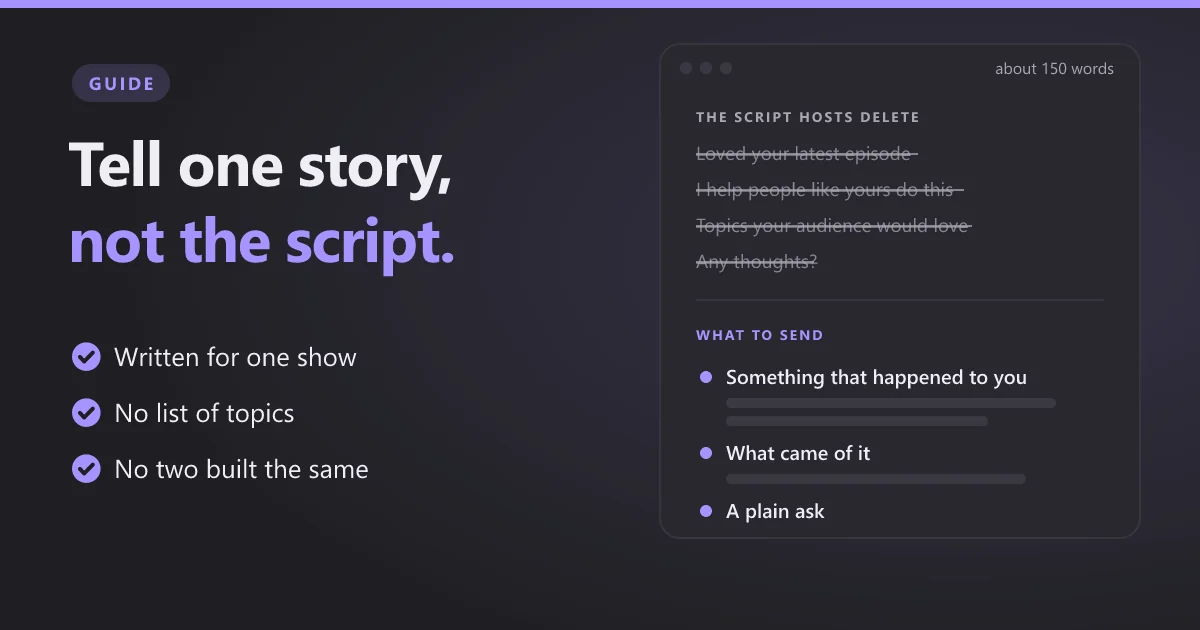
Podcast hosts are saying in public that they get the same pitch every day. In November 2026 Chris DuBois, a positioning coach who hosts a podcast, wrote on LinkedIn that he had reached his breaking point with it, and set the email out. It goes like this:
- A greeting.
- A line saying the sender heard the most recent episode, with praise for an idea taken from its show notes.
- A positioning statement that could describe anyone in the sender's field.
- Topics the host's audience would love, which the sender has already covered on other shows.
- A closing question: "What are your thoughts?"
What pushed him to post was that this one came from someone he had known for years, who could have sent him a message and asked. He wrote that he no longer wants that person on the show.
The replies came from other podcast hosts, and they agreed with him. One wrote the whole script back as a comment, and nobody needed the joke explained.
This guide is about what to write instead.
The short version
- Tell one story. Something that happened to you, chosen for this show.
- Say what came of it: what you now think, do or know.
- Ask plainly, in one sentence.
- Leave out the script: the episode compliment, the job-title line, the list of topics, and anything about the show's listeners.
- Keep it to about 150 words, with a subject line that comes from the story.
- If you know the host, send them a message instead.
- Follow up once after a week, in the same thread, with something new.
The pitch hosts now delete
None of the script's parts was always a bad idea. Here is what the hosts in that conversation said about each one.
- The episode line. Naming a recent episode used to prove you had done your homework. One host said that a message naming something he has published and praising his take on it is now an immediate no, because all it does is repeat the topic back to him. A couple of years ago, he added, that research put you at the top of the pile, and today it puts you at the bottom. Another joked that the pitches making a real effort mention the episode before the most recent one.
- The positioning statement. "I help this kind of person do that kind of thing" could have been written by anyone in your field, so it tells the host nothing about you.
- The topics their audience would love. A host knows their listeners, and you are guessing. A list of things you can talk about also reads as the list you send to everyone.
- The closing question. It hands the work back to the host, who now has to decide what you are asking for.
This format worked once. Then every booking agency and every guide to guesting published it, the writing tools learned it from them, and now everyone sends it. A host who has seen the outline a hundred times stops reading the sentences. It doesn't matter how good yours are.
What to write instead
Nobody in that conversation said what a good cold pitch looks like, only what a bad one looks like. So what follows is our answer, not theirs.
A host books a person, not a list of topics. What gets a yes is a host thinking "I want to hear this person tell that." So the pitch is a short note that holds three things: something that happened to you, what came of it, and an ask. They aren't sections, and no two of your pitches should be built the same way.
Start with something that happened to you
There are several ways in. Choose the one that suits your material and the show.
- A moment. One scene, and what you noticed.
- A decision. What you chose, what it cost and what it changed.
- A belief, and where it came from. An opinion you hold, told through the experience that formed it. The experience comes first.
- A turn. Where you were, where you are now, and what moved you.
- Something you built. What it was for, and what it showed you.
- A mistake. What went wrong, and what you do differently now.
An opinion with nothing under it is a topic, not a story. "Restaurants should watch their cash" is a topic. The Monday a client's card was declined, two days after her busiest weekend, is a story, and the opinion comes out of it.
Start inside the story, with what happened. Don't start with the show, or with who you are. Tell it plainly, with only what took place, and don't make it more dramatic than it was.
Choose the story for the show
This is where listening comes in. Check that the show is still publishing, because most podcasts have stopped. Then listen to an episode or two to learn what the show cares about, and choose which of your stories belongs there. The listening decides what you send. It doesn't have to appear in the email.
Mention an episode only when you have something to add to it. Chris's own test, in a reply, was that the outreach would work much better if the sender shared a real insight the episode had given them. If you have one, say it. If you don't, leave the episode out.
Say what came of it
One or two sentences on what you now think, do or know because of what happened. This is what you would bring to the conversation. It doesn't need a list beside it: if there is more you could talk about, the host will ask.
Ask plainly
End with one sentence that says what you want. It can ask whether they would have you on, ask whether the story is one they would want on the show, or offer a short call first so they can see whether you suit it. Write it fresh for each email.
Write the subject line last
Take it from the point of the story, in a few plain words: "A full dining room and a declined card". A host can tell from that line alone that nobody else sent this email. "Podcast guest opportunity" is what every other pitch in the inbox says, and so, by now, is the show's name followed by a topic.
What to leave out
- The episode compliment, unless you have something to add to the episode.
- Your job title and your bio. Say what you do only where the story needs it to make sense.
- A list of topics.
- Anything about the show's listeners. One wrong guess about them can end the email, however good the rest is.
- Praise for the show.
- Anything that sells. If the pitch is about your product, the host hears an advert.
- Links and attachments. Attachments look like spam, and your page for hosts can wait for the reply.
- Anything past about 150 words. If it needs scrolling on a phone, it's too long.
One old mistake still ends a pitch on sight: the wrong name. Check the host's name and the show's name before you send, every time.
Before and after
Here is one made-up guest pitching one made-up show, twice. First, the pitch hosts now delete:
Subject: Guest idea for Back of House: why busy restaurants still run out of cash
Hi Marco,
Your episode with Priya on supplier terms stuck with me, especially her point that most owners never ask for 30 days. It's the same pattern I see from the other side.
I'm a bookkeeper who works only with independent restaurants, about 40 of them across Texas. The question I hear most is the one your listeners probably ask too: why does a full dining room still leave the account empty?
A few things I could talk through with you:
- Why March and August are the months restaurants run out of cash, and how to see it coming
- The three numbers I check every Monday, and what each one warns you about
- What happened when one client stopped paying suppliers on delivery
My bio, headshot and past episodes are on my page for hosts: [link]. Happy to work around your recording schedule.
Thanks,
Dana
Nothing in it is untrue, and a couple of years ago it was a good pitch. Today Marco sees the outline before he reads a word: an episode, a positioning statement, his listeners, a list, a link. The best thing in it is buried in the third bullet.
Here is the same guest, starting from that bullet:
Subject: A full dining room and a declined card
Hi Marco,
One Monday morning a client of mine had her card declined at her fish supplier's counter, two days after the busiest weekend her restaurant had ever had. She called me from the car park, sure that someone had been stealing from her.
Nobody had. I keep the books for about 40 independent restaurants in Texas, and when we went through hers, every dollar was accounted for. She had paid for the weekend's stock on delivery, and the card payments from that weekend hadn't reached her account yet, so the better the weekend, the less she had on Monday.
We moved two of her suppliers to 30-day terms, and it hasn't happened since. Now, with every new client, I look at when they pay out and when they get paid before I look at anything else.
If the money side of a busy restaurant suits Back of House, I'd be glad to come on and talk about it.
Thanks,
Dana
It's about 150 words, and it starts inside something that happened. What Dana does for a living appears once, where the story needs it. There is no episode, no list and nothing about Marco's listeners, and the last sentence says what she wants.
A second example, from a different guest to a different show, so you can see that the build changes:
Subject: My best interview was my worst hire
Hi Kofi,
The best interview I ever sat through was with a man I hired on the spot and let go eleven weeks later. He was funny, quick and sure of himself, and I was running a twelve-person print shop with nobody on the front desk, so I didn't call a single reference. When I finally did, after he had lost us two accounts, his last manager told me in one sentence what I had spent eleven weeks finding out.
I've since hired about sixty people for other small firms, and I don't interview anyone until I've spoken to someone they have worked for. Owners tell me that feels backwards, and then they try it.
Would you be open to a short call first, to see whether a conversation about checking references before the interview suits The Second Hire?
Best,
Renee
This one has a different way in, two paragraphs where the first had three, and a different ask. If all your pitches have the same shape, you have written yourself a new template, and hosts will learn that one too.
If you know the host, send a message
The pitch that set Chris off came from someone he knew. If you have met the host, traded comments with them or share a friend, a two-line message does more than any email: say what you would like to talk about, and ask.
His advice to anyone who wants to get on shows was to start meeting people and building relationships, and to help hosts with what they are doing before asking for a spot. A cold email is still how you reach the hosts you don't know, which is most of them, and the rest of this guide is for those.
If someone pitches for you
One host in the replies said he has started contacting the people being pitched, to tell them what their agency is sending in their name. Not one of them, he wrote, was happy to hear it.
If an agency, a publicist or an assistant pitches for you, ask to read what goes out under your name. The same approach works in the third person: your story, what came of it and a plain ask, signed by the person who is sending it. There is more on this in what to ask a booking agency and in the guide to pitching for someone else.
How to follow up
Plenty of replies come after a follow-up, not the first email. Hosts are busy, and a pitch slides down the inbox.
- Wait a week, then reply in the same thread, so the host sees your original pitch below it.
- Add something new: another part of the story, or a reason it's timely. Not "just bumping this up".
- Keep it to two or three sentences.
- If there's still nothing, one more a couple of weeks later is fine. After that, let it go, and pitch the next show.
Here is a follow-up to Dana's pitch:
Hi Marco, one thing I left out: the restaurants I work with run short most often in March and August, and you can see it coming about six weeks ahead. I'd be glad to talk through how, if that's useful. Dana
When a host says yes
Reply quickly, confirm the date, the time zone and the recording platform, and send your page for hosts: one link with your bio, your headshot and your past episodes. Then get ready to be the guest they're glad they booked.
Questions
How long should a podcast pitch email be?
About 150 words, from the greeting to the ask. That is long enough to tell one story properly and short enough to read on a phone without scrolling.
Should I mention a recent episode in my pitch?
Only if you have something to add to it: a point you would build on, or one you disagree with. An episode named with a compliment is the opening hosts now recognize as a mass email. Listen to the show to choose what to pitch, and leave the episode out unless it earns its place.
Is there a podcast pitch template I can copy?
No, and a template is the problem. Hosts recognize an outline before they read the sentences. Keep three things in every pitch (something that happened to you, what came of it, and a plain ask) and build each email differently around them.
Should I email a podcast host or message them?
If you know the host, message them. If you don't, a short email written for that one show is still a good way to ask.
How CastGhost helps with the pitch
CastGhost helps you write each pitch this way, for one show at a time:
- It starts from your own material. Your bio, your talking points and your published work, each of which you have read and approved. It looks there for the story that suits the show, and adds nothing that isn't in them. Beside each draft, Built from shows what it used.
- It reads the show to choose the story, not to quote it back. The show's description and recent episodes decide which of your stories goes in the draft.
- Each draft is a short note with no fixed outline: about 150 words, in your voice, with its own subject line.
- You read it, edit it and send it from your own Gmail. Nothing goes out until you send it.
- Follow-ups are there when you need them. If a host hasn't replied after 7 days, the show turns up in Follow-ups, and one click drafts a short follow-up in the same thread for you to review.
Setting up your profile and finding shows that fit you are free, and you pay $2 when a pitch is drafted, follow-ups included. See how the drafting works and Pricing.