 CastGhost
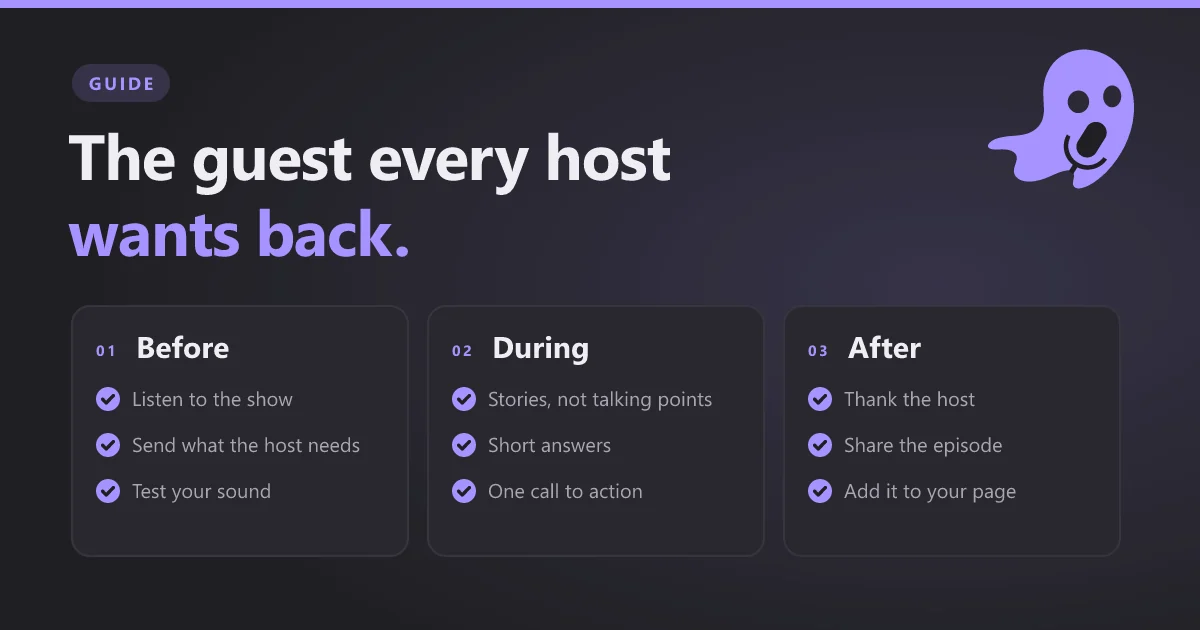
Getting booked is half the job. The other half is being the guest a host is glad they booked: someone who knows the show, tells good stories, sounds clear and helps the episode find listeners.
It matters past the one episode, too. A good episode is the best pitch you'll ever send. It's the link the next host clicks to decide whether you can hold a conversation.
The short version
- Before: listen to the show, send the host what they need in one go, and test your sound.
- During: tell stories rather than reciting talking points, keep your answers short enough for a conversation, and give listeners one place to find you.
- After: thank the host, share the episode when it goes out, and add it to your guest page.
Before the recording
Listen to two or three recent episodes. Notice how the host runs the conversation, how long the guests' answers are, and whether there's a question every guest gets at the end. If you're pitching through CastGhost, each show comes with a plain explanation of why it fits you, drawn from its recent episodes. That's a good place to start listening.
Get familiar with the host. A quick search online tells you a bit about them: what they do outside the show, what they've built, where they're from. You don't need to go overboard. Asking authentic questions is always great, but so is knowing a bit about who you're speaking to. It helps you connect your stories to their world.
Send the host what they need, all at once. That means an introduction they can read out, a short bio for the show notes, a headshot and the one link you want listeners to have. A page made for hosts makes this easy. Mine, simod.me/host, has a 20-second read-aloud intro, a short and a long bio, and a headshot to download. There's more on that in why every guest needs a page of their own.
Prepare stories, not a script. For each topic you pitched, have one story with something specific in it: a moment, a number, a mistake, what someone actually said. Listeners remember stories and forget bullet points. Know the one thing you'd like a listener to take away, too.
Choose your one call to action. At the end, the host will ask where people can find you. Give one short address, not a list. Make it something a listener can remember while they're driving.
Sort out the details. Confirm the time zone, the recording platform, whether there's video and how long it runs. Join a few minutes early.
Test your sound the day before. Wear headphones so the host's voice doesn't echo back into your mic. Pick a quiet room with soft things in it (a sofa, curtains, a bookshelf), not a kitchen. A USB microphone sounds far better than a laptop's built-in one, and you don't need an expensive one. Close everything that might ping.
During the recording
Answer the question, then stop. A minute or two is usually plenty. Long answers turn an interview into a lecture, and short ones give the host room to follow up on what's interesting.
Tell the story first, then the lesson. "We lost our biggest client in March" holds attention in a way "client retention matters" never will.
Talk to one listener. Picture one person who has the problem you solve, and talk to them. It keeps you specific and stops you sounding like a keynote.
Don't pitch. Mention your work when it's relevant, and save your call to action for the end, when the host asks. A guest who turns every answer into an advert doesn't get invited back, and listeners notice.
Build on what the host says. Refer back to something they said earlier, or to an episode you heard. It makes for a better conversation, and hosts remember guests who listened.
Fix mistakes out loud. Most shows are edited. If you lose your thread, pause and say "let me try that again". A clean second take is easy to edit; a rambling recovery isn't.
After the episode
Thank the host the same day. A short email is enough.
Share it when it goes out. Post it where your audience is, tag the host and the show, and pull out one idea from the conversation rather than just posting the link. Hosts notice which guests share their episodes.
Add it to your guest page. Each appearance makes the next host's decision easier. My Studio page lists every show I've been on, newest first.
Rate the show, and keep the questions. A rating or review helps a small show. The questions you were asked tell you what people want to know, in their own words.
Ask who else might be a fit. If it went well, ask the host whether they know another show your story would suit. Hosts know other hosts.
What hosts don't want
- A guest who hasn't heard the show.
- An answer to every question that turns into a pitch.
- A laptop microphone in an echoey room.
- A reschedule on the morning of the recording.
- Silence from the guest once the episode goes out.
Finding the shows
All of this starts with a show that fits you: an audience with the problem you solve, and a host who interviews guests. That's what CastGhost checks before you pitch. It reads each show's recent episodes, finds how to reach the host, and drafts a pitch from your own material for you to send from your own Gmail.
Setting up your profile and finding shows that fit you are free. You pay $2 when a pitch is drafted. See Pricing.