 CastGhost
When you're starting out, you can't afford much marketing, and you don't yet know which message will land. A podcast helps with both. A host gives you half an hour with people who chose a show about the problem you solve, asks the questions they'd ask, and leaves an episode that keeps working long after you've recorded it.
Here's how to make podcast guesting work at the earliest stage, when money and time are both short.
The short version
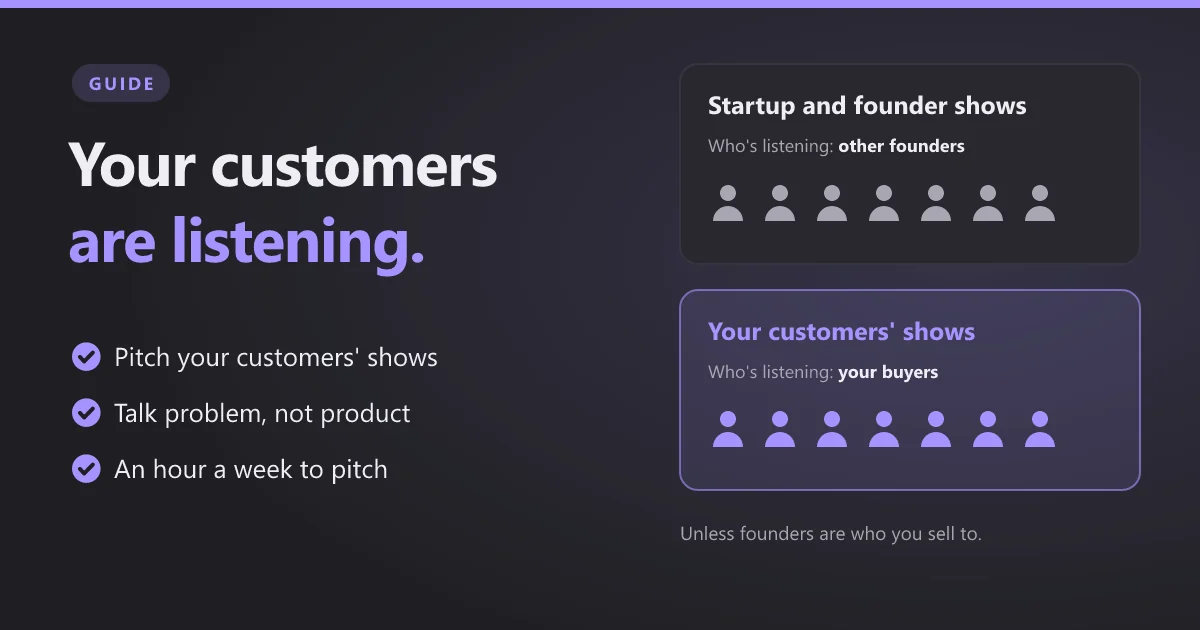
- Pitch your customers' shows, not startup shows. Founder podcasts mostly reach other founders, unless founders are who you sell to.
- Talk about the problem, not the product. Your story gets you booked. What you've learned about the problem is what listeners remember.
- Treat each episode as customer discovery. The host's questions, and what listeners ask afterwards, tell you how people really talk about the problem.
- Pitch for an hour a week, in batches, and keep time free for the recordings you book.
- Expect a slow burn, so don't pay for it like a sprint.
Why podcasts suit the earliest stage
- Your customers are listening. There's a show for almost every industry, role and problem, and its listeners are exactly the people you're trying to reach.
- The host does some of your customer discovery. A good host asks the questions their listeners would, and the questions show you which parts of your pitch land and which need work.
- It builds trust you can't buy yet. An episode is something a customer, an investor or a hire can listen to before they talk to you.
- It leaves links that last. Show notes link to your site, and those links keep sending people your way and help you in search results.
- It compounds. One appearance leads to people looking you up, and sometimes to the next show. I've written about what guesting has done for me.
Which shows to pitch
Your customers' shows
Start with who buys from you, and find the shows they listen to for work: their industry, their role, the problem you solve. If you sell scheduling software to dental practices, the shows to pitch are about running a dental practice, not about startups.
Startup and founder shows
These are fun to be on, and they're good for fundraising and hiring. But their listeners are mostly other founders. Treat them as a bonus, unless founders are your customers.
Small and new shows
A show with a few hundred listeners in exactly your niche is worth more to you than a big general one. Smaller shows are also far more likely to say yes to a founder nobody has heard of yet. Do check they're still publishing: most podcasts have stopped.
What to talk about
- The problem, in your customers' words. What you've heard in your customer conversations is the most interesting thing you have. Bring the patterns, the surprises and the numbers.
- A view someone might disagree with. "Most dental practices lose more to no-shows than to bad marketing" is a conversation. "We help practices run better" is an advert.
- Your story, briefly. Why you started is usually what gets you booked, so keep it to a minute and get to what you've learned.
- The product, only when it's relevant. Mention it when it answers the question being asked, and save your one call to action for the end. More on being a guest hosts want back.
Turn each episode into discovery
- Write down the questions. The host's questions, and how they phrase them, are how your market talks about the problem.
- Give listeners somewhere to go. One short address, ideally a page for listeners of that show, with a way to talk to you or try what you've built.
- Listen back. The answers you fumbled are the parts of your pitch that need work, on podcasts and in sales calls.
Fit it into your week
Podcast guesting doesn't need a day a week. It needs a routine:
- Pitch in batches, for an hour a week. Ten shows at a time, then let the replies come in.
- Record in clusters. Each recording takes an hour to an hour and a half, so group them into a couple of afternoons rather than scattering them through the week.
- Reuse every episode. A clip, a post with one idea from the conversation, a line in your newsletter, and a link on your site.
What it costs
Most founders can't justify a booking agency at this stage: one agency's campaigns start at $1,500 a month, with a six-month minimum (who that suits, and who it doesn't). And because the payoff from podcasts builds over months, a monthly subscription bills you while you wait for it.
That's why CastGhost charges per pitch:
- Searching is free. Set up your profile from your site, your LinkedIn and your writing, and see which shows fit before you spend anything.
- A pitch is $2, written for one show from your own material, in your voice, with nothing invented, and sent from your own Gmail. Ten shows cost $20.
- Each customer segment can be its own search. If you sell to two kinds of customer, each can be its own pitch niche, with its own shows and pitches. You start with one, adding credit unlocks a second, and you can ask for more.
- Credit never expires, so pitch hard around a launch or a raise, and pause when you need to.
See Pricing, or how to write the pitch yourself.